Posts

Showing posts with the label story

There are no true stories.

Image
Why would you read a novel? It's not even true. Do you believe that non-fiction books are "better" because they are "true?"  NLP (neurolinguistic programming) offers an interesting perspective on how language works. It uses words to anchor experience, so that every communication with language is completed by the receiver. The words are not the point: the connection is the point. In the meta-model, it is understood that language necessarily distorts experience because it cannot create a one-to-one correspondence between what the words say and the experience represented by the words. This isn't because people are trying to be misleading. It's the way language works. There is no evolutionary advantage to being able to predict the past or to being so accurate that no one else can connect with what you are saying. Stories are never true (even if they really happened) because they are all experiences that are communicated through language. Language necessarily...

Sharing a story outperforms delivering a message

Image
Do you meet people at events and wonder "so what's their story?" You might even ask. What you expect in return is not a fairy tale. It's not a presentation. It's an account of what matters to them and why it matters. "What's your story?" is how we say: "We see you have an emotional investment in something here. What matters to you and why?" Do you know how to answer the question. You can just tell people: "I'm here because this matters to me because. . ."  You might even say out loud "this matters to me and I think it should matter to you, too." But you might not. Because we want to be invested but we also want to be cool. We want to be passionate, but we also want to be inoffensive. It's hard to tell your story without caring about what the other person is thinking. That's the brilliance of telling a story instead of giving a speech. If you answer the question (real or implied) with a story ...

Use colour to trigger emotional connection

Image
Well hello, springtime! Imagine this picture in black and white. It's a collection of bushes in full leaf against some trees with a house in the background. That doesn't offer much of a story. It doesn't call out to you to connect. But in full colour, you know that this is the kind of spring day that makes people smile as they pass you on the sidewalk or the trail. In colour, this picture invites you to stand next to me and marvel with me at the blue of the sky and the exuberant yellow of the forsythia. In colour, you know that this is a picture of promise and potential. When you're communicating, you're probably tempted to either avoid the colour (and tell your stories in black and white, just the facts) or to avoid the story (just describe life as it is). The problem with this is that understanding takes an effort and if you want other people to make that effort, you have to give them something that promises the effort will be worth it. Just the facts, t...

Seeing to the bones of your message

Image
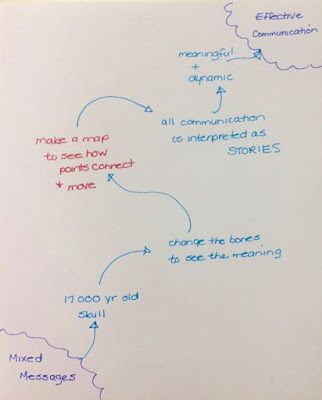
I heard on the radio this morning that archeologists have discovered the skull of a 10 year old boy who died 17,000 years ago in Calabria, Italy.  They are going to use the imprint his brain left on his skull to recreate the brain of the boy so that they can compare it to the brains of modern children. Learn more here.  There are always connections between the bones and the brain, between structure and meaning. Usually that connection is hidden by other stuff, the muscles and skin and decoration that make it hard to notice the frame underneath. By digging out the bones, you become aware of the meaning that sits behind your words and drives the effect they make.  Here are the bones of this post. A skeleton like this gives you choices. The bottom left corner is for the current situation. The top right corner is for the change you want to make with your communication. Now make a map (use arrows and place the points strategically) of the beginning and e...

The two stories we tell: finding and fighting

Image
I have been working with an advanced communication group and thinking about the quickest way to catch the story someone is telling so that you can support or change it. It seems to me that the essential question to ask is this: "Is this a story about finding something or is it a story about fighting something?" There might be other options, but for the moment, let's assume that it's useful to start with this one frame. Finding or Fighting? Problem solving is generally pitched as a fight against something (although some people love to explore for answers). Creativity is generally framed as a finding of something (but some people describe it as a battle). There is no set formula: you have to listen for clues in the words and structure that someone is using in a message. Once you have a working idea whether they are working to find something or to fight something, you can listen to chunk down further. People look for things they have lost, things they know exist ...

Engaging the monkeys in a conference room

Image
 Carole Luft opens Leading Words    On Saturday, we held an unusual conference. Although it began much as every conference begins (with a welcome from a podium), there had been an unusual amount of hugging as people found their seats. Scattered around the tables were monkeys–monkey cutouts, monkey stickers, monkeys sitting in the fancy chair at the front. Everywhere were reminders of what the Buddhists call Monkey Mind. And our goal for the day was to get the monkeys to focus, engage, and show their most loving, cooperative, and ingenious selves. What do you think of when you think about monkeys? Do you imagine playing, shrieking, mischief or cuddles? Do you think of mindless activity or of a sudden, focused interest in a puzzle to be solved? All of these are typical of monkeys. All of these are typical of the monkeys in your mind–the troop of ideas, emotions, biases, memories, and hopes that are in perpetual motion as you try to focus, to think, to make decisions. ...

Storywork: What to hear in a story about being lost

If I asked you if you like being lost, you would probably say no. Lost is one of those words with a built in set of feelings and "like" is not part of the set. If I asked you to tell me about a time you got lost, your story might tell me something different. It might tell me that you like to explore, that you enjoy being on your own and self-reliant, or that you are excited by new possibilities.  We would probably laugh, especially if the story was about a time when you were scared. Our fears often make us laugh, after they have passed. If I listened to your story about being lost, I'd have a very good idea of what it would be like to work with you through a new challenge. I'd know how likely you would be to cross edges, shake up patterns, or strategize through a situation with no clear paths.