Posts

Showing posts with the label words

When you want to connect, your words have to ride your energy

Image
Buy it at Amazon It works every time, even if you're speaking a second language or working in a field that is new to you. Here's the magic formula for effective communication: knowing what you want + paying attention to other people = words that work.  I know this seems too hard. I know you are tempted by the people who teach another script, another voice lesson, another theory of body language that will supercharge your communication. I know that it seems easier to work on your words than it does to work on being so clear about the results you want that you are able to dedicate most of your attention to the people you want to influence. Attention is harder to manage and maintain than a script. But scripts don't work well without it. Your attention is signalled by energy: people notice when you're directing energy at them. They pay attention to it. And when they do, your words can ride that energy and land deeply and effectively. But if you expect the...
Is it an accident or a failure? The right label matters

Image
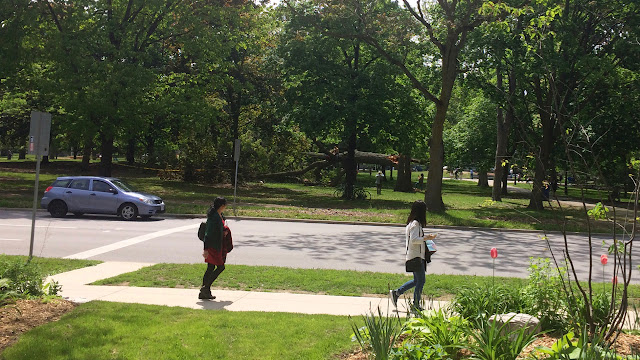
This was the view from the training room window on Friday. A very large tree had come down in the park on Thursday night. All day, people stopped to examine the trunk and think about what had happened. Was it an accident?  It hadn't been chopped down, so it was clearly not something that had happened on purpose. But to call it an accident suggests that it couldn't have been helped. It also suggests that the rest of the trees are likely to remain standing. If on the other, hand, it was an infestation, then there is something that needs to happen now. Someone needs to check the rest of the trees. While it's possible that the first tree could fall by accident, if any more fall we will call it something else - something like incompetence or failure or fault. Sometimes, the label we choose tells us how to act next. If we choose the wrong label, it is likely to lead to the wrong action. Take a moment now to think about a problem or issue you have been facing....

How to focus your communication

Image
Some people think that the bigger the words they use, the more focused their communication will be. The reasoning is usually fuzzy, but goes something like this: Bigger words often have more precise meanings. So using more big words must mean that you are expressing a more precise meaning (a subset of narrowly defined words). This may be true of the dictionary meaning of your words. It's not true of how most people will process them. You need two qualities to help people focus on your words. The first is that you have a key message you can state simply and directly. This becomes the touchstone for everything else you write. It all points back to this clear key message. The second quality you need is sensory coding. People focus on what engages their senses. If your words point them to sights and sounds and feelings, their attention will wrap around your words. Your readers or listeners will be so busy filling in the sensory information that your words suggest, they will let...

Clear and concise communication results from knowing your audience

Image
Take a look at the picture. Is it a picture of bare trees or of trees that are just about to burst into leaf?  Your interpretation depends as much on you as it does on this picture of trees in late April. Your words are like the bare branches of these trees. When you choose them well, they burst into leaf in the minds of your listeners or readers. Just a few words can grow into a rich impression. When you choose without enough thought, your concise expression will just be bare branches. Too often, we think that qualities like "clear" or "concise" are absolutes, qualities that are found in the writing alone. They are actually descriptions of a relationship between a communicator, an audience and a message. They define the sweet spot where the fewest words have the greatest impact because they represent shared experience and understanding. Think of a time someone has been abrupt with you: you were given a bare branch but not enough information to i...

Calm: A quiet space in a complicated world

Image
Here's what we imagine family life to be: serene, calm, harmonious. At least, this is how we imagine other people's families, the ones we see in the perfect Facebook photographs. Our own families are more. . . complicated. Family Day weekend is a good time to reflect on perfect images. As I write this, the sun is shining on bright white snow. It's also about 25 below zero (celsius). It's a great day to sit by a window. We think that photographs tell the truth, but they only ever tell part of the truth. Words are like that too. They turn our focus to one thing, and other things disappear. Even when we use words like complicated, we miss something. There are elements in every situation that are simple, uncomplicated, true. When you use a word like calm, you can focus on difference. Calm is not complicated, not crazy, not loud, not anxious.  Or you can simply focus on one thing that is grounded and real and clear. As you read this, you can hear that last phrase: g...