Posts

Showing posts with the label nlp

A place for us: where do you have your best conversations?

Image
 Try this thought experiment. Think of three wonderful conversations you have had. You might not remember what you said or even what you heard, but you remember the flow of words and the way you felt. Now look around each of those memories. Where did they happen? Now connect the "where" to the "what." Some wonderful conversations are wonderful because they make you feel so close. You feel that you and the other person (or even a group) are sharing a mind and heart. And often those conversations happen in close spaces, spaces where you share so much in your senses that it is easy to share similar thoughts and feelings. Other conversations require more space. High ceilings or wide open skies. The room to stretch your legs and create motion. An expanse around you that creates expansiveness in your thoughts. People get confused by science. They think that because science is rational, the only way to be practical is to pretend that our bodies are separate from our reason...

Are you in a good place?

Image
 Place is such a basic metaphor, that sometimes we forget there is a difference between our physical location and our state of mind. We've all heard that the thing that counts in real estate is "location, location, location." There's a good reason for that. According to research described by Annie Murphy Paul in The Extended Brain , we use our surroundings as a way to prompt our thoughts. When we are out in nature, we think one way and when we are staring at a computer screen, we think another. Although our experience of our thoughts is that they are related to content, often the kind of thoughts we think are also related to context.  We have a lot of language about place: we have to find our place and know our place (sometimes in that order). While it's hard to change what goes on inside our heads directly, it's easier to change our place. We can get up and move to a new location. We can choose a walk under trees or a quiet, safe den (we name our thinking spa...

There are no true stories.

Image
Why would you read a novel? It's not even true. Do you believe that non-fiction books are "better" because they are "true?"  NLP (neurolinguistic programming) offers an interesting perspective on how language works. It uses words to anchor experience, so that every communication with language is completed by the receiver. The words are not the point: the connection is the point. In the meta-model, it is understood that language necessarily distorts experience because it cannot create a one-to-one correspondence between what the words say and the experience represented by the words. This isn't because people are trying to be misleading. It's the way language works. There is no evolutionary advantage to being able to predict the past or to being so accurate that no one else can connect with what you are saying. Stories are never true (even if they really happened) because they are all experiences that are communicated through language. Language necessarily...

Are you waiting or are you growing?

Image
Have you been stuck in a waiting room for the past three months, or have you been building something? The lockdown has changed a lot of things, but it hasn't change this basic choice. We are always either circling or growing. Usually when we are circling, we are running from one thing we know to another in a cycle. Other people look and see busy. We see busy. But that doesn't always mean growth. It can mean wearing a rut in our thinking. The lockdown grabbed us by the shoulders and said "sit still." It felt like being plunked into a room and being told "wait here." Wait for the news that will change your life. Wait for the principal. Wait for the dentist's drill. Kill time until you get back to your real life. Many people were already living in the waiting room. They were hoping something would change around them, that something would  open up new possibilities. But their minds kept running in the same patterns, so they kept seeing and doing the same thi...

Growing stronger is more satisfying than just hanging in

Image
Photo by Ivan Babiy at scop.io Are you hanging in? There's a sense these days of life suspended - I mean both that it feels like we have been left hanging and that we have been shut out of our real lives for an unspecified amount of time (probably much longer than you hope as your fingertips begin to bleed). Some people have lost their work and some are overwhelmed by work. Some are trying to be full time parent/teachers/caregivers while also doing their day jobs. As if. They are quickly becoming their evening into night-time jobs too. They don't have a choice about their circumstances. They do have a choice about how to respond, and so do you. You can hang in there and hope that you will adapt (or that life will go back to normal before you have to adapt). Or you can recognize that many, many changes are coming, and you can start developing the strength and flexibility to build a life that satisfies you, no matter what happens. If you've read this blog befor...

When did you become two people?

Image
When I look at this picture, I see one speaker. It's me. I don't see a personal me and a work me. I don't see the brave me and the hidden me. I see me. I know you've read that you should have boundaries between your work life and your private life. There is wisdom in allowing yourself to experience all of yourself and that can mean creating time and space to be present wherever you are. There is no wisdom in sending a version of yourself to work and keeping a different version at home. What do you see when you look at a picture of you at work? People often call me at NLP Canada Training  and say something like "It's just for me." or "I'm interested for work." The problem is there is no such thing. You are one person and who you are changes your influence on the people who connect with you. The reverse is also true. If you don't change your own thinking or responses, you are unlikely to make change in the way you lead and influence....

Difference is the Difference That Makes a Difference

Image
http://www.cbc.ca/books/canadareads/meet-the-canada-reads-2018-contenders-1.4505780 John Ginder is one of the founders of NLP (neurolinguistic programming) . He has said, "Difference is the difference that makes a difference."  What does that mean? It means that before you can grow or change, you need to let new information into your system. But your system (your brain/mind/body all working together) automatically filters out most new information.  It takes will power to pay attention to something you don't already expect. Which brings me to the picture above. Canada Reads just launched its books and their defenders for 2018.  Maybe you will take the time to read the five books and play along when the debates start. I will.  And I am pretty sure already that I will not like all five of the books. That's sort of the point. You might get stronger by confirming biases and over learning what is already familiar. But you won't grow. You won't change. Yo...

Happy Birthday, Canada - it's okay to be imperfect if you keep trying

Image
Today is July 1 - Canada Day, and because Canada 150 is a big deal, it's been greeted with big protests. Everywhere on social media, protestors are disrupting the celebration because Canada has not always been good to them or for them. I get it. You're mad. Somebody screwed up and you want us to fix it (even though exactly how to do that is up for some debate). You're angry because you're stuck and you don't see a way to make it better. You're angry because you're black, you're indigenous, you're left wing, you're right wing, or you've been left out in the rain or out of the speech (sorry, Alberta). Here are some house rules you might consider based on something called the six step reframe in NLP: 1) it's better when you can generate lots of new ideas - innovation takes cooperation and respect 2) the best ideas come from our best selves - the ones Canadians try to remember in celebrating a national birthday (ideals li...

Can you analyze and agree at the same time?

Image
What do these words mean to you? The Meta Model classifies them as distortions and generalizations. But to the people who put them on these sticky notes, they represented a very specific shared experience. Part of the reputation of NLP was established by its approach to language. The Meta Model  promises to help you look beneath what people are saying to discover what they really mean. It's based on understanding language as a distortion of reality. Even if it were accurate (I wouldn't argue that), it's a framing that is almost bound to get you into trouble unless you remember one cardinal rule (most people don't). The rule is this: you can only dig deeper with permission and you can only tell you have permission when you are spending most of your attention building agreement. As a coach, I sometimes work with high performers on analyzing their patterns of thought or behaviour so that we can identify leverage points for change. This is stressful, but the...

The meaning of an action is the feedback it receives

Image
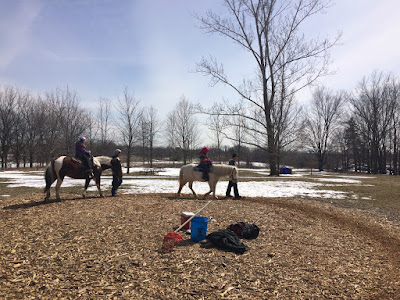
A pony named Callie and a small horse named Tonto follow each other around small, endless circles. Have you ever had a job like that? I don't know how the animals feel about it. But I know what they were accomplishing. I put a 5 year old girl on Callie and I knew she was being brave. She really wanted to ride the pony, but ponies are quite large animals when you are 5 years old. Riding the pony wasn't just a treat: it was an accomplishment. There are days my work can feel like walking in small, endless circles. I keep doing it in the hope that some people will be able to practice being brave and feeling connect to something just big enough and different enough to scare them a little. In NLP, we say that the meaning of a communication is the feedback it generates. Remember to look for the results before you decide that going in circles means you're not making progress.

Plans are not just maps: they are tests of your commitment to an outcome

Image
Photo Credit: Tamara Polajnar We make a plan when where we want to accomplish something. We want change to happen, and we list the actions we will have to take to make it happen. When we do, we assume that the plan is a roadmap: it describes a territory that we will have to navigate. I have come to believe that this is probably not what makes plans useful. In the map above, the mountains and loch are real (I visited them recently and can confirm they are there). But the steps in a plan are not real: they describe something that has not happened and that might never happen. Actions in a plan are not like the roads on the map. They are more like thermometers that measure your commitment to your outcome. At this moment, do you want this enough to take this action? If you do, take the action and then take the next test. In NLP, we would call this a test of your congruency. Congruency requires that all parts of you are engaged in moving in the same direction. The difference b...

Is time management really energy management?

Do you have enough energy for what you want to do? So many people are busy managing their time, and yet they can do nothing to change the number of hours in a day or days in a week. The calendar programs and expert tips all talk as though 5 minutes were always 5 minutes. And yet, you have experienced 5 minutes as an eternity and 5 minutes as a heart beat. In NLP, we would say that your state determines how much time 5 minutes contains. When people complain they don't have enough time, I wonder if they are really saying that they don't have enough energy. It's a much different question and harder to solve with an app. It would mean that instead of auditing how productively you spend your time, you would need to understand your personal economics of energy. What if every activity consumes energy but some activity also produces energy? You know this is true. It always takes energy to get started. But sometimes you are so engaged in something that you become more energize...

Bring out the Best

What's the difference between your best result and your typical result? Sometimes the world does align to support your performance and you get a personal best result. But that's probably not what came to mind first. Research shows that we usually attribute our best performances to our own skills, strengths and effort. We believe that we have more influence over our outcomes than is probably the case. What came to mind first was probably your own skill, attitude or effort. Before you rush in to correct this error, consider its usefulness. Whether or not it is true that our efforts determine our results, it is a useful belief that motivates us to change the only things we can change: the factors within our own control. To get a personal best, we believe that we need to be our personal best. We use a different version of this logic when we are managing the performance of others. We attribute much of their success to circumstances outside their control and blame their less-th...

Managing your outcomes when you are sick on game day

You've been waiting for this day for weeks - actively preparing so that you'll be at your best when you need to perform. You've researched and rehearsed and you are ready. Until the bug hits, the one that has been going around the office or the school. You're all set and you're sick. Now what? There are times when there is no choice. You're too sick to carry on and so you miss it. Other arrangements get made. What I want to think about now are the majority of days, the days when you have a wicked head cold and you have to face a 2 hour commute before presenting to a room filled with important people you want to influence. You have choices. You could cancel and begin the long, hard process of preparation again.  You could muddle through miserable and hope for sympathy points from your audience. Or you could excel despite the bug. You could be so committed to your outcome that you show up fully and let go of most of the rotten feelings until after you'...

Autonomy, Mastery, Purpose and Connection: A Well-Lived Life

The new year is still a baby, and we don't want to load it with too many expectations. Most of you will not be working because it is an official holiday: one of the few shared by people of all faiths and backgrounds. This is the pause before the downbeat, the moment before 2015 really gets going. I think it's a good day to look forward and backward and think about what makes life worth living. It sounds like a big, important question (and it is) but it is also a question we answer every day with the choices we make and the things that we do. Your answer is not what you would say if asked: your answer is what you choose to be important from one day to the next. Once I had a business partner who always said his ultimate goal was to not have to work. He had no concept of work being something that shaped you as you shaped it into something of value, something of influence, something that was inherently worth doing. This caused a certain amount of difficulty, since I believe tha...

What makes a great conference?

Image
It is interesting to me that most of the NLP (neurolinguistic programming) conferences of which I am aware run exactly like other conferences: they put experts talking at the front of the room (usually with powerpoint) in unremarkable hotel rooms. This seems to me unfortunate. Why not use the practices and principles of NLP to create format that satisfies people's goals for attending a conference? While it is certainly true that people go to conferences to learn new things, it is more true that most people go to conferences to learn while making new connections and planting seeds for further development and networking. Most NLP conferences do no better or no worse than other mainstream conferences in giving participants opportunities to meet those goals. People sit and listen, and then mingle and make small talk during breaks. Whether or not the speakers are good is not really the point. The point is that the framing doesn't really facilitate meeting the outcomes. At NL...

The difference between resources and results

I was inspired by Chris Brogan's post at Owner this morning . Chris got me thinking about how what we notice drives our behaviours which drives our results. What are you measuring when you try something new at work? We tend to move between two poles. At one extreme, we measure results. We know what we want and that's all we measure. At the other pole, we measure reassurance. Are we getting gold stars? Does someone who counts approve of our efforts? As employees, we tend to work for some form of gold stars although we are more engaged and more successful when we are able to see the results of our work and measure those instead. As entrepreneurs, we want to measure results but until we get them, we would like some gold stars. It's hard to work on your own and hope you're doing something worthwhile. It's nice to get a gold star. It's nice, but ultimately, your ability to continue to do what you want to do depends on your results. More than anything, as an ent...

Myths of false precision in NLP manuals

I have been reading an NLP book. I won't say which one, only that it includes many instructions that include what I would call a false precision. Let me give you an example. Anchoring is a technique that associates a particular physical stimulus with a state, memory or behaviour. In NLP, anchoring is widely used to stabilize, modify or create states that are suitable for particular situations or tasks. Many instructions will tell you to set an anchor just before an experience peaks. This is nonsense. You only know the peak by the descent from it. You cannot set an anchor just before an experience peaks because you do not have access to that level of detail about the future, nor can you read someone else's state so accurately that you notice the difference between at the peak and just past the peak. You can pretend to accuracy, but not achieve it. I know that the people who write this stuff believe they have developed a meaningful level of precision. There is just a lot of...

Moving beyond NLP to incorporate new models for positive change

As 2014 approaches, I am aware that I must soon sit down and put together my year end video. It's often a little unnerving to look ahead, especially since by the end of December I am tired and ready to climb into a burrow for some quiet alone time. I think winter brings that out in a lot of people. My job is to tempt people out of their burrows so that they forget to think about being comfortable and think instead about what could engage their full attention in a way that is satisfying and productive. Life is less about being and more about doing and I work to get people very busy being more fully alive. This means that I only get to retreat into a burrow when it is to be very engaged with deep, internal process that will eventually break through to cause more action. I have been reading other people's NLP practitioner manuals and guides, and I still believe that everything I teach is compatible with the best in NLP practice. Not everything is the best, and not everything i...

Why giving thanks is an NLP thing

Here in Toronto, it's Thanksgiving weekend.  It seems to me that thanksgiving is the most NLP of all the holidays. It involves knowing what you want and recognizing it in what you already have. When we pay attention to something, it tends to become bigger. Whether this is because we attract more of it, or because we simply notice it more, is not as important as the impact on how we experience our lives. When we recognize the value in what we already have, we feel better about ourselves and our world. Practically speaking, the fastest way to make your life better is to pay attention to what is already working. It's hard to be thankful when you are focused on what is broken, lost or out of reach. If you're feeling thankful now, stop reading and go celebrate. If you're not feeling thankful yet, if the holiday feels like words without meaning, then take a moment and think about what you would fight to save. It's easier to think about fighting than gratitude when you...