Posts

Showing posts with the label communication

A simple approach to defining what you want

Image
There are lots of experts who will tell you what to do once you know what you want. They will give you motivational tips (which means they are not based on emotion, not evidence) and they will give you evidence-based tips (often the result of social science research). What they don't do is tell you what to do when you don't know what you want. After all, if you don't know what you want, what's the point? People think that you must know what you want. And that's probably accurate on some level, but your conscious awareness might be out of the loop. I spent a large part of this week asking people to grow their influence by knowing what they want other people to do. I kept asking people what they wanted. The answer that no one wanted to give out loud was something like "I would like people to be impressed by me just as I am, and I'd like them to figure how to use the information I give them. I don't want to have to think it through, because I'm not...

How to start a powerful message

Image
We often invest a huge amount of time and effort in planning our message. We want it to be clear and strong and motivating and bullet proof. We argue and support, find more evidence, and rehearse. We work hard to make the message as strong as it could possibly be. And when we fail to be heard as we want to be heard, we blame ourselves for delivering it the wrong way. This makes it harder the next time we have to walk into a conversation or a presentation and deliver a strong, clear message. What if our delivery was fine and the problem was that the audience was not ready to hear us? The most powerful messages all begin with the same thing: the speaker finds a way to say to the audience, "I see you." © Can Stock Photo / ueuaphoto The one thing that you can be sure every audience wants is a mirror. Before they care about how you see your subject matter, they want to know how you see them. When you reflect what you see in your audience, you do two things: 1) help them...

Sharing a story outperforms delivering a message

Image
Do you meet people at events and wonder "so what's their story?" You might even ask. What you expect in return is not a fairy tale. It's not a presentation. It's an account of what matters to them and why it matters. "What's your story?" is how we say: "We see you have an emotional investment in something here. What matters to you and why?" Do you know how to answer the question. You can just tell people: "I'm here because this matters to me because. . ."  You might even say out loud "this matters to me and I think it should matter to you, too." But you might not. Because we want to be invested but we also want to be cool. We want to be passionate, but we also want to be inoffensive. It's hard to tell your story without caring about what the other person is thinking. That's the brilliance of telling a story instead of giving a speech. If you answer the question (real or implied) with a story ...

Use your common senses to communicate more clearly

Image
What's the difference between a concept and a formula?  Between a strategy and a blueprint? Between a hypothetical and an example? In each of these pairs, the first one is impossible for most people to imagine. They know what the word means, but it is not attached to any sensory representation.  The second one is equally "business-like," but it's something a reader or listener could imagine using their senses. They could see or hear or feel something that would tell them more than the word itself about what you wanted to communicate. © Can Stock Photo / Konstanttin Artists regularly turn concepts into images. Good speakers and writers do the same thing: they evoke the senses so that people have something easier to observe and remember than abstractions are. This doesn't mean being choosing more descriptive words: it means imagining what you want to communicate as something you can see, hear and feel and then stripping your language down to match what you ar...

When you want to connect, your words have to ride your energy

Image
Buy it at Amazon It works every time, even if you're speaking a second language or working in a field that is new to you. Here's the magic formula for effective communication: knowing what you want + paying attention to other people = words that work.  I know this seems too hard. I know you are tempted by the people who teach another script, another voice lesson, another theory of body language that will supercharge your communication. I know that it seems easier to work on your words than it does to work on being so clear about the results you want that you are able to dedicate most of your attention to the people you want to influence. Attention is harder to manage and maintain than a script. But scripts don't work well without it. Your attention is signalled by energy: people notice when you're directing energy at them. They pay attention to it. And when they do, your words can ride that energy and land deeply and effectively. But if you expect the...

Can You Be Clear And Connected At The Same Time?

Image
I wonder if you've ever struggled to stay connected to someone as you were communicating something important to you? It often seems that connecting to someone is a distraction from our message, rather than the purpose for it.  It's hard to stay clear about what we want to say when we also have to be clear about what someone else will hear in our words. This is the central paradox of communication: for a message to be clear, the sender of that message must hold onto their own vision while connecting with someone else's. There's a benefit to this paradox. As we become less sure of what we want to say, we are more likely to engage in shared thinking. We come up with ideas together when we communicate in ways that are unclear enough to encourage participation. As you struggle to be both clear and connected, think about this. If you had to sacrifice either clarity or connection, which would be most important? Giving up clarity makes room for collaboration. Givin...

Use colour to trigger emotional connection

Image
Well hello, springtime! Imagine this picture in black and white. It's a collection of bushes in full leaf against some trees with a house in the background. That doesn't offer much of a story. It doesn't call out to you to connect. But in full colour, you know that this is the kind of spring day that makes people smile as they pass you on the sidewalk or the trail. In colour, this picture invites you to stand next to me and marvel with me at the blue of the sky and the exuberant yellow of the forsythia. In colour, you know that this is a picture of promise and potential. When you're communicating, you're probably tempted to either avoid the colour (and tell your stories in black and white, just the facts) or to avoid the story (just describe life as it is). The problem with this is that understanding takes an effort and if you want other people to make that effort, you have to give them something that promises the effort will be worth it. Just the facts, t...

Are you asking for what you want?

Image
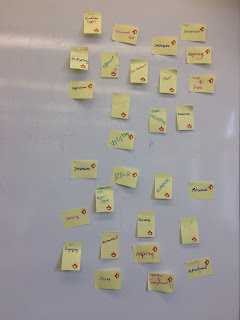
We're all good at knowing what we don't want. Often our anxiety to avoid problems and pain is so present that it drives our communication. We tell people what we don't want. What changes when we get better at simply defining or describing what we do want? We experiment with this every time we run a program at NLP Canada Training.  We start by asking two questions: What do you want to change because you came to this program? What do you want to be true of the group today? Here are the answers from our recent practitioner retreat. It was a full day gathering to explore rhythm as an aspect of leadership. The words at the top described what they wanted for themselves and the words at the bottom described what they wanted from the day.  You can compare them to the words they used at the end of the day to describe their experience. On the one hand, this is nice feedback on the program we ran. On the other, it's a demonstration of the difference it can...

You're not writing to a computer; you're writing to a person

Image
From time to time, we are all writers. We all post and email and some of us prepare documents to communicate ideas or information. Writing can be a lonely activity: it feels like it's just you and the computer screen. As you try to wrestle your information into words, your vision might close in until there is nothing but you and the screen you are filling with your words. This is a terrible way to think about writing. Even your personal journal will make a better contribution to your well-being if you look up and around. You are not writing alone: you are writing because you are not alone. Even if the person who will read your writing is another version of you, you are writing so that someone can read what you have written and make sense of the world differently because of it. If you were writing code for a computer, the computer would carry out your instructions. The interchange might get ugly if you wrote ugly code, but there would be no escalation of bad feelings and bad ...

The US Election: The meaning of your communication is the outcome it gets

No picture in the post this week, and no politics. Just three communication principles applied to the US Election results. The first principle: matching states (pun unavoidable) creates rapport. Trump matched a mood of discontent and anger that is apparently epidemic throughout most of the states (as in United States). Literally, he won because he matched the state in more states (that's the way the Electoral College works). It's not clear to me that Trump did more than mirror: I haven't seen evidence that he can lead from the state he has matched into a more useful state. But when people looked at him, they saw their own state reflected back. Since states shared are states amplified, he has successfully created a wave of anger and discontent and that wave has carried him into office. The second principle: repetition creates reality. This is basic to advertising: if we hear something repeatedly, it will stick in our brains and when we are not actively engaging our criti...

The invisible force that speeds things up or slows them down

Image
Photo Credit: Jose at Flickr I don't play the drums. You probably don't play the drums, either. At least, you probably don't have a drum kit in your office to set the beat for your work communication.  But it might be really helpful. Rhythm is the invisible force in language. While everyone is preoccupied with what words mean and how long they are and whether they are spelled correctly, rhythm nudges attention in different directions, changing the effect that words have on a listener or reader. Long can be complicated or long can be a gentle ramble, soothing the reader into a calmer, more open state. What's the difference between complicated and soothing? It's the rhythm of the sentence. Instead of trying to understand the technical practice of rhythm in language (it's complicated), why not simply practice noticing the rhythm in speech or writing? As you read this, tap a finger to what you think is the rhythm you are picking up. As you listen to someon...

Putting the frame on the outside

Image
The beautiful building where we train at NLP Canada Training  is currently covered with scaffolding. The roof is being repaired and replaced, and it will be a slow job. In the meantime, our warm brick is covered with a metal skeleton. It's not pretty, but it is useful. Think about this scaffolding when you have to repair or replace the way your audience understands the thing you want to communicate. Be especially careful when that understanding is keeping them safe from the elements in an unpredictable environment. For instance, people frequently come to me with a version of "I don't like this thing that happened to me in the past and the way it has me stuck now." Their understanding of the current situation is like a roof: it both limits how far they can see and gives them a measure of predictability in an unpredictable world. It's a trade-off: to protect themselves from a world where bad things might happen, they focus on a bad thing that has already hap...

Surprise! Language doesn't have to make sense to be effective

Image
Recently I read a very good book by Amy Herman called Visual Intelligence . In the end, however, I thought her comments on effective communication should have been defined better. Her advice is very good when the purpose of language is to have information jump from one person to another. But that's not the only purpose of language. There are other roles for language to play, and other ways to use it brilliantly. Surprise! A burst of lavender doesn't make sense but it does activate your senses. While it is useful to be preoccupied with making sense (which means taking sensory information and understanding it as having meaning), it is less useful to be preoccupied with having your words make sense. Here are three times when you might be brilliantly effective by being less clear and sensible: Your primary purpose is to build a connection. If this is true, your language needs to mostly mirror the style and strategies of the person or people with whom you are speaking. Thi...

A bridge can be breathtaking

Image
This is the boardwalk at Greenwich in PEI's National Park. It allows people to cross a fragile ecosystem and a pond to reach a beach that is absolutely breathtaking (I'll put a picture at the end of this post, so you can get your own glimpse of it). The boardwalk reminded me this week that the work it takes to build a bridge is not compromise and it's not a necessary evil. It's a necessary beauty, an effort to connect resources and build something that is both useful and beautiful. This is how I like to see communication. Communication of all kinds requires that we build bridges: we must build them with the craftsmanship that knows what will be stable and what will last in different environments. The work is often painstaking and troublesome and it feels like the slow way to a result. And yet, when it succeeds, communication builds connections that are not only strong and stable: they are beautiful in their own right. I can guarantee that you will need ...

Trusting the silence in conversation

Image
Silence doesn't sound scary while you're looking at a photo of a path through the woods. Primed by this photo, you are likely to imagine silence as calming or peaceful.  In the middle of an important conversation, this may not be your first reaction to silence. Most often, when we say something significant and get silence in reply, we are rattled. Silence is not processed as calming; it's processed as a warning. The quieter it is outside, the more alarms go off in our brains. "Danger!" Is silence always a bad sign? Probably not.  Think of a time when someone said something and your reaction was "I need to process this." The time when you were processing was best spent in silence (processing out loud is not always a good idea, even for extraverts). This processing time could have been used to do many things: to understand; to tease out an association at the edge of your awareness; to think several jumps ahead; or to disagree. Disagreement...

Seeing to the bones of your message

Image
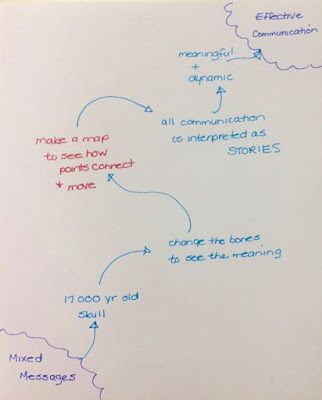
I heard on the radio this morning that archeologists have discovered the skull of a 10 year old boy who died 17,000 years ago in Calabria, Italy.  They are going to use the imprint his brain left on his skull to recreate the brain of the boy so that they can compare it to the brains of modern children. Learn more here.  There are always connections between the bones and the brain, between structure and meaning. Usually that connection is hidden by other stuff, the muscles and skin and decoration that make it hard to notice the frame underneath. By digging out the bones, you become aware of the meaning that sits behind your words and drives the effect they make.  Here are the bones of this post. A skeleton like this gives you choices. The bottom left corner is for the current situation. The top right corner is for the change you want to make with your communication. Now make a map (use arrows and place the points strategically) of the beginning and e...

Frames are the bones of good communication

Image
No matter what you wear, your bones give it shape. You can change clothes, change your style, add padding, pull in loose bits with shape wear and still, your bones give your shape. Although no one can see them (we hope!), they change what everyone sees. Your communication has bones too. These bones give shape to your writing or speaking; they tell people how to interpret what you are saying. If they don't think the bones fit their expectations, they won't have a container that allows them to hold your information. If they think the bones fit their expectations too closely, they'll assume they already know what you are going to say and they'll remember what they thought you meant (and not what you meant to say). Consider this mannequin. It has so skin and no clothes, but you know immediately that it represents a body in motion and you can make predictions about the kind of movements and the direction it is moving. Frames in communication allow us to do the same thing...

How to focus your communication

Image
Some people think that the bigger the words they use, the more focused their communication will be. The reasoning is usually fuzzy, but goes something like this: Bigger words often have more precise meanings. So using more big words must mean that you are expressing a more precise meaning (a subset of narrowly defined words). This may be true of the dictionary meaning of your words. It's not true of how most people will process them. You need two qualities to help people focus on your words. The first is that you have a key message you can state simply and directly. This becomes the touchstone for everything else you write. It all points back to this clear key message. The second quality you need is sensory coding. People focus on what engages their senses. If your words point them to sights and sounds and feelings, their attention will wrap around your words. Your readers or listeners will be so busy filling in the sensory information that your words suggest, they will let...

Clear and concise communication results from knowing your audience

Image
Take a look at the picture. Is it a picture of bare trees or of trees that are just about to burst into leaf?  Your interpretation depends as much on you as it does on this picture of trees in late April. Your words are like the bare branches of these trees. When you choose them well, they burst into leaf in the minds of your listeners or readers. Just a few words can grow into a rich impression. When you choose without enough thought, your concise expression will just be bare branches. Too often, we think that qualities like "clear" or "concise" are absolutes, qualities that are found in the writing alone. They are actually descriptions of a relationship between a communicator, an audience and a message. They define the sweet spot where the fewest words have the greatest impact because they represent shared experience and understanding. Think of a time someone has been abrupt with you: you were given a bare branch but not enough information to i...

Is your reason for communicating hiding in plain view?

Image
Can you see the snow leopard in this picture? It's in the centre. Snow leopards are rather spectacular, yet the camera shows us that they can also hide in plain sight. How clear is your purpose for communicating? The most common problem I uncover as a communication coach is that people haven't really thought through what they want. Like the snow leopard, their purpose is in the picture, but it's not easy to see. The single most important thing you can do to improve your writing or speaking is to decide before every communication: what do I want to change in my reader or audience? What do I want them to think or do differently because I communicated? And then ask: "What will that get me?" Repeat the question until you're sure you've come to the deepest, best outcome for the email or blog post or presentation you are preparing. When you give your mind/brain/body a clear description of what you want, that system is remarkably good at adapting to circums...