Posts

Showing posts with the label leadership

Are you asking for what you want?
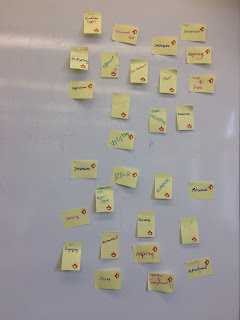
Image
We're all good at knowing what we don't want. Often our anxiety to avoid problems and pain is so present that it drives our communication. We tell people what we don't want. What changes when we get better at simply defining or describing what we do want? We experiment with this every time we run a program at NLP Canada Training.  We start by asking two questions: What do you want to change because you came to this program? What do you want to be true of the group today? Here are the answers from our recent practitioner retreat. It was a full day gathering to explore rhythm as an aspect of leadership. The words at the top described what they wanted for themselves and the words at the bottom described what they wanted from the day.  You can compare them to the words they used at the end of the day to describe their experience. On the one hand, this is nice feedback on the program we ran. On the other, it's a demonstration of the difference it can...

What difference does it make when you get in sync?

Image
Brad Cheeseman Trio at The Steel City Jazz Festival, 2016 Most people think that having more influence means one of two things: either they can somehow eliminate resistance so people will do what they want or they can achieve enough status and power so that people will do what they want. There's nothing wrong with either of those as goals, but there are many things you might want people to do that won't come from choosing the right words or having the power to make people comply. I am a teacher, and I often teach adults who have more money and power than I do. I don't have a carrot or a stick to motivate them to do what I want them to do. Even if I did, carrots and sticks are not good motivators of self discovery, of reflection or of the pause that comes before a sound decision. The influence I want will not come from carrots or sticks. So I have to look for other models of influence and leadership. This is one of the reasons I listen to ...

Leadership begins with a shared direction

Image
Photo Credit:  fishhawk There are two kinds of people: the ones who want to be the leader and the ones who don't want to be the leader. Sadly, there's not always a correlation between the ones who want to lead and the ones who are the best fit to lead. Whether or not you think of yourself as a leader, think about this. Leadership requires that the person leading and the people following all want to move in the same direction. Often, this will mean that they share a goal or purpose. Sometimes it will mean that they share a problem or a belief. But they have to want to move and they have to want to move in the same direction before conditions are right for someone to become a leader. If you're trying to take the lead, begin by checking what you know about where people want to go and what makes them want to move.

Vision: Leadership begins with seeing what is there

Image
When you think of the word "vision," two quite opposite things come to mind. One is physical sight: the ability to see what is in front of you. The other is a more grand and sweeping concept of how the world could be different than it is. Understanding the link between these two apparent opposites is the key to improving the way you walk into your future. It's always a good idea to begin with what we can test. You can play different games to find out how good you are at recognizing what you can see with your physical eyes. We all have been guilty of searching for something that is right in front of us and of walking through a room (or a textbook) and instantly forgetting what we have seen there. Our visual awareness is a bit sketchy. Perhaps we need another word. We distinguish between hearing (which is a physical capacity) and listening (which is something we do with our attention). We don't have the same distinction with our eyes: we see something with our physi...

How to make a decision (ask lots of questions)

Have you ever been astonished by a decision made by someone close to you? You know this person well. You respect them. And then - apparently out of the blue - they make a decision you didn't see coming. Sometimes, of course, the person who makes an astonishing decision is even closer to us: we all surprise ourselves from time to time.  As much as we gather information and perspective, as much as we truly believe that it's important to think things through, as much as we are committed to living smart, intentional lives: we surprise ourselves. There's actually quite a lot of information on how people make decisions. Daniel Kahneman's book, Thinking Fast and Slow , is likely to be a classic on the subject for some years.  For those who prefer a little less density and a more direct line to application, there's Decisive by the Heath brothers. There's no reason for someone who is involved in motivating, coaching or managing not to have at least a little familiar...

Coaching with strong mind, strong heart, strong stomach

Influence is not always fun. Supportive influence is not always fun. If you want to communicate in a way that gets results, it will feel good overall. It might not feel good all the time. Let's take coaching as an instance of supportive influence that can be tough on your sense of yourself and your beliefs about the world. This is not the popular view: visit any of the coaching associations or training advertisements and you won't find this caveat: This activity may break your heart or your spirit. Caution is encouraged.  Nope. Instead you find definitions about 'partnering' and language around 'empowering.'  Yes and. Coaches training should ask: Do you know how to develop a strong heart, a strong head, and a strong stomach? Some days, your clients will take your work and run with it. And forget that you had anything to do with it. Yes, of course it is optimal when your clients own their changes. But be honest: where is your satisfaction (and your business...

Applause is contagious

One of the most effective tips I have learned after decades in post-secondary teaching and adult education is this: encourage people to applaud for one another.  The form of the applause will change depending on the situation, but the effectiveness of applause will be constant across different ages and different circumstances.  Applause is contagious. What happens when people clap?  It doesn't take long before they begin to smile. And not long after that, they begin to suspect that there's something worth applauding. This is true whether they offer genuine applause or whether they applaud because the leader tells them it is required. I have watched many different people under the influence of applause. Most of them look embarrassed, at first. They look like they are not sure that the applause is really for them. And then, after it starts to become clear that applause is non-negotiable, something lovely begins to happen. Although people might still squirm a little, the...

Managing Pain at Work

There's a kind of rule that people stop having bodies when they get to work, at least in jobs that do not involve obvious physical labour.  To be professional is to stick to ideas and tasks and objectives. That means that while we may ask "how are you?" we really mean something like "of course you are fine because you are at work." We mean this although we all have experience of the difference between working when we feel well and working when we are in pain. How do you feel when you think about police officers, fully armed and allowed to drive, on patrol while suffering from migraine, back pain or sleep deprivation?  What about when you think of your doctor or nurse making decisions or giving medication while distracted by pain?  Perhaps the person marking your child's exam is suffering from a repetitive strain injury or nerve problem. Someone in pain is and is not disabled. They do not want to give up the chance to do their work and we, as a society, d...

Improving your choice of words

There's a truism that says you are more likely to hit something if you are aiming at it. We say things like "keep your eyes on the prize" and mean that paying attention to your outcome is likely to give you both a strategic advantage and the willpower to persist until you achieve what you want. We say these things because they represent a hard lesson. Take, for instance, a desire to be better spoken, to be able to talk in a way that impresses people more favourably. Most people try out new words or model great speakers in a concentrated effort to improve their choice of words. Ironically, their very first steps take their eyes off the prize. The prize is the good impression you make on a specific person or in a particular situation. And the only way to know how to make that impression is to become curious about the people and situation you want to influence. You need to notice what actually captures positive attention, what needs to be true for people to pay attention...