Posts

Showing posts with the label framing

3 Ways to Improve Your Mindset as COVID Winter Approaches

Image
  Fall is a little magical. We notice the light, and forget a little that it is easier to see the sky because there are fewer leaves every day. At the end of this lovely path is winter. In Canada, even bright winter days are short. Overall, the winter is dark and often damp and sometimes very cold. Patios are less attractive after Christmas and even walking is harder in wind and ice. So we all know what is coming, and we know that COVID will make it worse. What we need to know is what will make the coming season better? Stretching a little now will set you up for more of what you need in the months to come. Here are three practices to get you started: You might not have run an actual marathon, but you have had projects and experiences that seemed like marathons. These are your foundation: the evidence that you CAN keep going and the models of strategies that work for you. Lean into them. Be curious about how you managed to stay focused and keep moving. How does that help now? Peopl...

Putting the frame on the outside

Image
The beautiful building where we train at NLP Canada Training  is currently covered with scaffolding. The roof is being repaired and replaced, and it will be a slow job. In the meantime, our warm brick is covered with a metal skeleton. It's not pretty, but it is useful. Think about this scaffolding when you have to repair or replace the way your audience understands the thing you want to communicate. Be especially careful when that understanding is keeping them safe from the elements in an unpredictable environment. For instance, people frequently come to me with a version of "I don't like this thing that happened to me in the past and the way it has me stuck now." Their understanding of the current situation is like a roof: it both limits how far they can see and gives them a measure of predictability in an unpredictable world. It's a trade-off: to protect themselves from a world where bad things might happen, they focus on a bad thing that has already hap...

Seeing to the bones of your message

Image
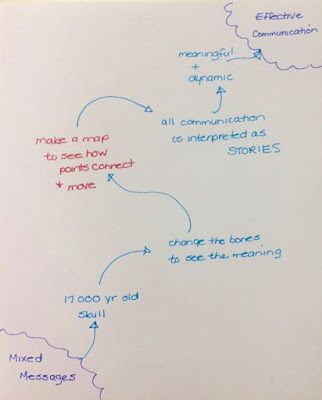
I heard on the radio this morning that archeologists have discovered the skull of a 10 year old boy who died 17,000 years ago in Calabria, Italy.  They are going to use the imprint his brain left on his skull to recreate the brain of the boy so that they can compare it to the brains of modern children. Learn more here.  There are always connections between the bones and the brain, between structure and meaning. Usually that connection is hidden by other stuff, the muscles and skin and decoration that make it hard to notice the frame underneath. By digging out the bones, you become aware of the meaning that sits behind your words and drives the effect they make.  Here are the bones of this post. A skeleton like this gives you choices. The bottom left corner is for the current situation. The top right corner is for the change you want to make with your communication. Now make a map (use arrows and place the points strategically) of the beginning and e...

The two stories we tell: finding and fighting

Image
I have been working with an advanced communication group and thinking about the quickest way to catch the story someone is telling so that you can support or change it. It seems to me that the essential question to ask is this: "Is this a story about finding something or is it a story about fighting something?" There might be other options, but for the moment, let's assume that it's useful to start with this one frame. Finding or Fighting? Problem solving is generally pitched as a fight against something (although some people love to explore for answers). Creativity is generally framed as a finding of something (but some people describe it as a battle). There is no set formula: you have to listen for clues in the words and structure that someone is using in a message. Once you have a working idea whether they are working to find something or to fight something, you can listen to chunk down further. People look for things they have lost, things they know exist ...

Frames are the bones of good communication

Image
No matter what you wear, your bones give it shape. You can change clothes, change your style, add padding, pull in loose bits with shape wear and still, your bones give your shape. Although no one can see them (we hope!), they change what everyone sees. Your communication has bones too. These bones give shape to your writing or speaking; they tell people how to interpret what you are saying. If they don't think the bones fit their expectations, they won't have a container that allows them to hold your information. If they think the bones fit their expectations too closely, they'll assume they already know what you are going to say and they'll remember what they thought you meant (and not what you meant to say). Consider this mannequin. It has so skin and no clothes, but you know immediately that it represents a body in motion and you can make predictions about the kind of movements and the direction it is moving. Frames in communication allow us to do the same thing...

Purpose: It's a word that takes up a lot of space

Image
Living Your Purpose by Linda Ferguson Purpose is an interesting kind of word. It's not a long word and almost everyone has some idea what it means. And yet it is a word that takes up a lot of space. Try this. Think of a situation where you are part of a group that is stuck, busy or at a crossroads. Imagine the response when someone says: "What are we trying to do here?" Now go back to the beginning of that scene and replay it. This time, the person who speaks says: "What's our purpose here?" Do you feel the difference? That's what I mean by taking up space. When we hear the word purpose, we pull back to a really wide perspective as though we are suddenly viewing ourselves from a distance.  The fear is that if we go too far back, we are such tiny creatures that our purpose can't matter very much. If we don't go back far enough, we can't see the purpose through all the complications. Getting it exactly right works better if we le...

The difference one word makes

Image
What do you see in this picture? If you had to choose just one word to describe it, what would that word be? Would it be BEGINNING? People are always celebrating a FRESH START. Do you think this is what they envision? A fresh start begins with destruction of what came before. Nothing begins fresh - even a tiny embryo carries a lifetime of baggage in its DNA. To change, we need to destroy. Or we can look at this picture another way: destruction is the way the soil is prepared for new growth. We seldom speak in just one word. We speak in long, flowing patterns of words. And yet, within those patterns there will be a word with oomph, a word that defines the mindset represented by our language. This word is the frame through which we see, the state the describes our experience. If you had to choose just one word to jump from this picture, what word would you choose?

A bird's eye view for clearer decisions in troubling times

Image
Have you ever tried to solve a tough problem by digging deeper and thinking harder? How did that work for you? Most people find that the deeper within they dig, the more complexity they uncover. They are emotionally engaged in contradictory ways. They want incompatible things. The evidence points in different directions. With every turn, the maze becomes less familiar. There's a better way. When you notice that digging is not helping you get clear on a decision, let go. Let your imagination carry you out of the maze so you can survey it from high, high above. Rising above a problem does not begin with taking the moral high road. It begins with moving to a perspective that is free, moving, and distant. Imagine trying to tell a seagull what to do. You can watch them on the beach. Even other seagulls have little success in being the boss of a seagull. Now imagine watching that gull take flight. What would it feel like to simply lift yourself away from the squabbles and bumps?...

Commands are less reliable than you might think

I've been developing two courses at the same time. One is our new course on Hypnotic Language and the other is the Business Communications courses I teach at Sheridan College. Theoretically, teachers fall into the class (joke!) of people who can tell other people what to do. Teaching is a great way to find the limits of that theory. Here are three ways I make it more likely that my students will do what I tell them to do: When I really need compliance, I use a tone of voice that lets them know it's time to do what I say. This is a voice that rings out with my determination to get an outcome. It's not really about them: it's about presenting an outcome so clearly and compellingly that they are likely to do what I've asked before they notice that they have started or stopped. When I don't really need compliance, I suggest or offer or encourage or give permission. I frame - which means I tell stories or give explanations that put people into a mood (or state,...

No pain no gain?

One of my favourite high school teachers used to say "We grow through pain." I didn't buy it then, and I don't buy it now.  I look at small children and small plants. They are wonderful examples of growth. And no sane person believes that pain makes them grow faster or better. It's the sunshine the brings out the crocuses, not the ice storms. I think we all want to believe that pain causes growth because it makes sense of pain. Since we all experience pain, it's rather nice to think that we gain something from the experience. We are even motivated to make that seem true, motivated to turn our thoughts or our actions in a new direction after pain. For the past two months, I have had the opportunity to explore pain from the inside. A yoga injury led to a back problem which led to problems standing.  I have become creative at manoeuvring through my day without being too limited by my limits. It does not feel to me like growth. It feels to me like being stoppe...

Influence Begins with Knowing All of What You Want

It's crazy hard to know exactly what you want. That may be part of the reason that the people who take the time to figure it out have so much power.  In a room where most people are a little fuzzy about what they want, the person who really knows is much more likely to move effectively. Have you ever wished for more patience? The true answer is no. People don't want patience: they want results. Patience is a sort of consolation prize at best.  When someone says they want patience, what they really mean is they want something they can't see unless they open their eyes to a bigger picture. What they want is most likely a combination of certainty within themselves and a positive relationship with someone around them. Patience indicates that the frame is too tight for them to see a possibility of moving forward together. That tight frame makes patience much less likely. That tight frame makes it hard to see beyond a moment of irritability or conflict. That tight frame mea...